
How Hand Gestures Improve Communication and Public Speaking (2026)
The hands reveal everything about a presenter. They tell an audience whether you are thinking or retrieving, whether you are in command of your content or managing anxiety, whether your conviction is real or rehearsed. After 20-plus years coaching professionals at Apple, Microsoft, Monster Energy, and Sony, with more than 1,200 five-star Google reviews from people who came into our workshops unsure of what to do with their hands, we know this: deliberate gesture is not a presentation technique. It is a delivery skill. Research on gesture and speaker credibility consistently shows that speakers who use coordinated, purposeful hand movements are rated as more competent, more confident, and more persuasive than those whose hands are frozen or moving without intention. Your hands are already communicating every time you stand in front of a room. The question is whether they are reinforcing your message or contradicting it.
Why Your Hands Matter More Than You Think
Most presenters treat gesture as a stylistic choice. It is not. It is a processing aid for your audience.
Research on gesture and information retention has consistently found that listeners retain significantly more of what a speaker says when that speaker uses appropriate, coordinated hand movements. The reason is rooted in how the brain processes incoming information. When gesture and speech are synchronized, they activate multiple cognitive channels at the same time. The listener is not just hearing the message. They are also seeing it. That redundancy strengthens encoding and makes recall more reliable after the presentation ends.
The reverse is equally true. A speaker with frozen hands places the full cognitive load of the message on the verbal channel alone. A speaker with random, uncontrolled movement creates visual noise that competes with the verbal message. Both patterns reduce how much the audience takes in and how much they retain. This is why so much of effective communication is physical, not just verbal. The hands are one of the most visible and readable signals in that physical layer, and they are operating whether you are managing them or not.
Three Types of Gestures That Do Real Work
Not all gestures are equal. After coaching 27,000-plus professionals through our workshops, we have identified three types of gesture that consistently do the most work in a professional presentation.
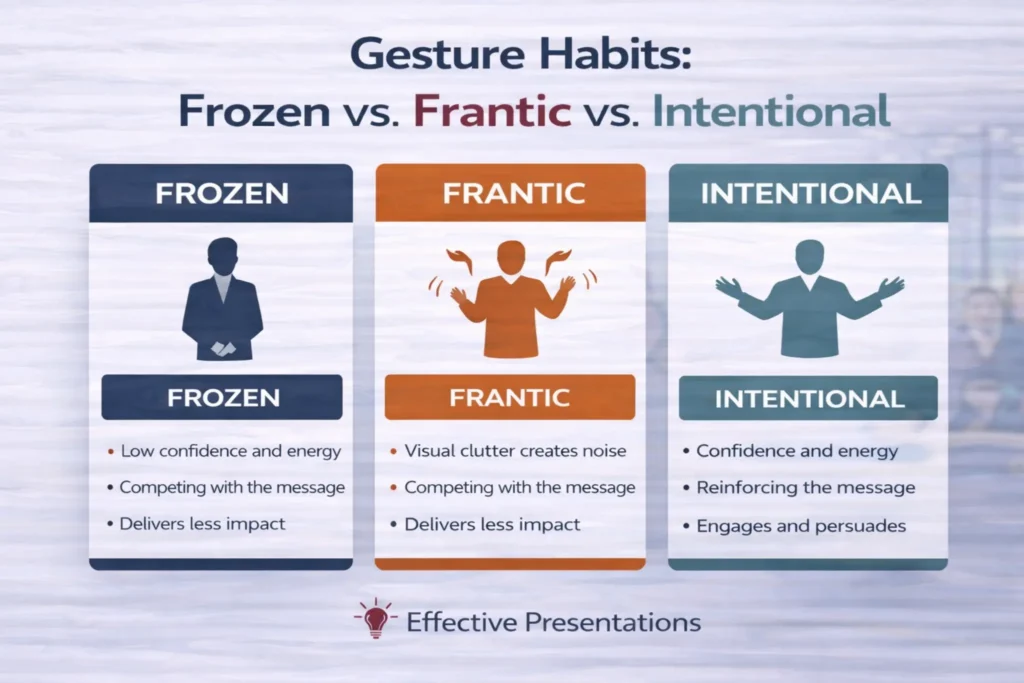
Illustrative gestures paint pictures with your hands. When you describe a process with three stages, you hold up three fingers. When you explain that two ideas are in tension, you place your hands on opposite sides of your body. When you talk about growth over time, your hand rises. These gestures give the audience a visual representation of the concept you are describing. They reduce cognitive load and improve comprehension, particularly for abstract or complex material where words alone leave a gap.
Emphatic gestures drive key points home. A slow, deliberate downward press of an open palm on a critical claim. A measured point toward the screen when a specific number matters. A contained fist when the message is about conviction or commitment. These gestures signal to the audience: this is the thing that counts. Used sparingly and with intention, emphatic gestures direct attention exactly where you need it.
Regulative gestures manage the room. An open palm extended toward someone you are inviting to speak. A slow, horizontal movement that holds a question until you have finished a point. A brief, settled gesture that signals you are transitioning to a close. These gestures give you active control of the room environment, particularly useful in Q&A, panel settings, and interactive workshops where the conversational flow is not scripted.
The problem with most untrained presenters is not that they use the wrong type of gesture. It is that they use no intentional gesture at all, or they use all three types randomly and without coordination to their words, which reads as agitation rather than authority.
What Bad Gesture Habits Cost You in the Room
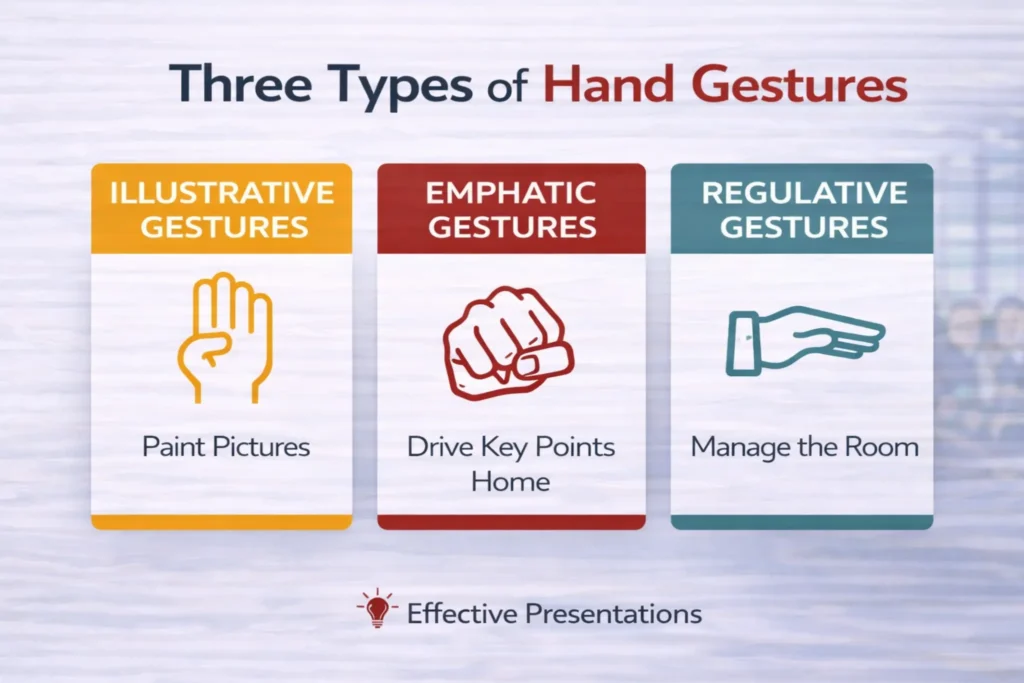
The frozen presenter is the most common pattern we see in our presentation skills training workshops. Hands gripped at the sides. Hands clasped in front. Hands locked in pockets. The instinct behind this is understandable: when you are anxious, any gesture feels like too much movement, so you lock down.
Here is what that costs you. Frozen hands read as low confidence and low energy. They make vocal delivery harder because gesture and voice are neurologically linked. Release the hands and the voice opens up. Lock the hands and the voice tends to flatten with them. And frozen hands deprive your audience of the visual reinforcement that helps them encode and retain what you are saying.
The opposite problem, unconstrained movement, costs you something different. Hands that move constantly without coordination with speech create visual noise. The audience’s attention follows the movement instead of the message. This is the pattern of a presenter who is gesturing to self-manage anxiety, not to communicate. It reads exactly that way.
Crossed arms and hands gripped together in front of the body signal defensiveness or discomfort. Even when that is not how you feel, that is what the audience sees. Body language signals are processed before the words land and they color everything that follows. The audience’s judgment about your confidence is forming in the first 30 seconds, mostly from physical signals.
The goal is neither frozen nor frantic. It is intentional.
How to Use Gestures Effectively When You Present
The most important principle is this: let gesture arise from the content, not from a performance decision.
When you are describing a concept that has three distinct parts, you do not need to remind yourself to gesture. If you know the content well and you are genuinely engaged with communicating it, the three fingers will come up naturally. Gesture is downstream of engagement with your material. The more present you are with what you are saying, the more your hands will do the right things without deliberate management.
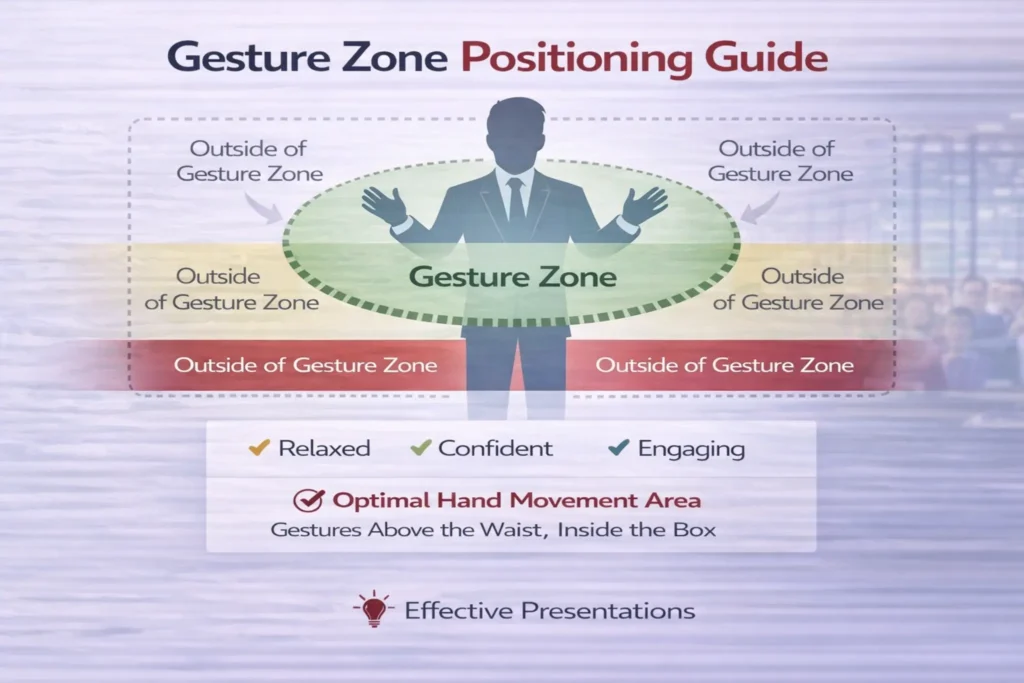
What you can train is the gesture zone: the area from your waist to your shoulders, roughly arm-width wide, in front of your body. Keep your gestures inside this zone and they read as confident and contained. Gestures below the waist tend to disappear visually in a room of any size. Gestures above the shoulders feel agitated. Most presenters who come to us either have no gesture zone at all because their hands are frozen, or they have a zone that sits too low, with the hands moving below the waist where much of the audience cannot see them.
Research on gesture-speech coordination and timing shows that gestures are most effective when they arrive slightly before or simultaneously with the relevant spoken word, not after it. If your hand comes up after the key word lands, the visual reinforcement arrives too late. This is why untrained gesturing often feels decorative rather than functional: the content and the movement are not coordinated.
In our public speaking training program, we use video playback to show presenters exactly where their gesture zone sits and exactly when their gestures are arriving relative to their speech. Seeing it once does more than reading about it twenty times.
Building Better Gesture Habits
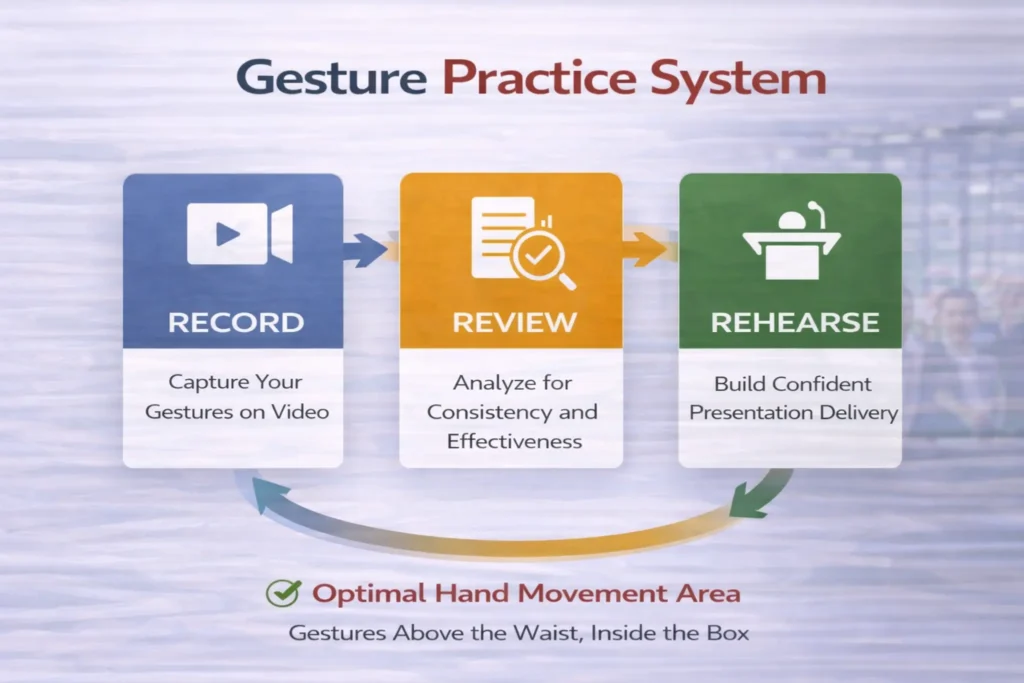
Recording yourself is the fastest path to real improvement. Not to criticize. To observe.
Most presenters are genuinely surprised the first time they watch a recording of themselves presenting. The frozen hands they did not notice. The grip-and-release pattern they were not aware of. The repetitive chop that happens every time they make a declarative statement. These habits are invisible to the person doing them and obvious to everyone watching. A single video review identifies all three of them in under ten minutes.
Watch the recording once through without stopping. Write down three specific physical habits you want to change. Then rehearse again with those three things as the only focus, not the content, not the slides, just those three physical behaviors.
Do this rehearsal in real conditions: standing, at full volume, in a space that is physically similar to where you will present. Seated rehearsal does not train standing delivery. The body needs to learn the skill in the same context it will perform it. This is the same principle we apply in our 1-on-1 coaching work, and it is why coached rehearsal produces faster change than any amount of reading or passive observation.
Get feedback from someone who will be specific. A peer who says “it looked great” is not useful. A coach who says “your hands drop below your waist in the first 30 seconds and stay there for the first three minutes” is. That level of specificity is what creates real change. Working on vocal variety and physical gesture together, rather than separately, is where the most significant delivery shifts happen because the two systems reinforce each other.
One client came to us preparing for a TEDx talk. She had been rehearsing the content for two months. It was excellent. Her delivery was disappearing because her hands were permanently clasped at waist height, her gesture zone did not exist, and her voice was flat because the physical delivery had nowhere to go. Over four coached sessions focused specifically on physical delivery, the presentation changed entirely. The content stayed the same. She changed.
If you want coached, structured practice with expert feedback in a workshop environment, our executive coaching program and public speaking workshops are built around exactly this kind of delivery work. Because the goal is not to know more about gestures. It is to be a different presenter the next time you walk into a room.
Frequently Asked Questions: Hand Gestures in Communication
Why do hand gestures matter in public speaking?
Gestures improve how much your audience retains from your presentation. When gesture and speech are coordinated, they activate multiple processing channels simultaneously. The listener is hearing the message and seeing a visual representation of it at the same time. That redundancy improves encoding and recall. Speakers who use deliberate, coordinated gestures are also rated as more credible and more persuasive than those whose hands are frozen or moving randomly.
What is the correct gesture zone when presenting?
The gesture zone is the area from your waist to your shoulders, roughly arm-width wide in front of your body. Gestures within this zone read as confident and contained. Gestures below the waist tend to be invisible to much of the room. Gestures above the shoulders read as agitated. Most untrained presenters either have no active gesture zone because their hands are locked, or a zone that sits too low to be useful.
How can I stop freezing my hands when I present?
Record yourself presenting and watch the playback. Identify exactly where and when your hands freeze. Then rehearse standing, at full volume, with your only focus being those specific physical moments. The freezing is usually driven by self-monitoring: when you are focused on how you look, the hands lock. When you are genuinely engaged with communicating content to an audience, the hands tend to release naturally. Concept mastery and real-conditions rehearsal are the fastest paths to fixing the freeze.
What are the three most useful types of gestures for professional presentations?
Illustrative gestures visualize what you are describing: three fingers for three points, hands apart for contrast, a rising hand for growth. Emphatic gestures signal what matters most: a palm press, a contained point, a deliberate pause with hands still. Regulative gestures manage the room: an open palm inviting a question, a horizontal hold gesture managing interruption, a settled close gesture signaling transition. All three work best when they arise from genuine engagement with the content rather than from conscious performance.
Can gesture habits actually be changed, and how long does it take?
Yes. Gesture is a physical habit and physical habits are trainable. Most professionals see significant change within three to five coached, video-reviewed rehearsals focused specifically on physical delivery. The key is specificity: identifying the exact habits that need to change, rehearsing in real conditions rather than mentally or seated, and getting feedback from someone who can name what they are seeing with enough precision to act on.